How to choose an HRMS for the GCC
Start with the countries where you employ people, then check each requirement country by country. Wage protection: salaries must be paid through each country's wage protection system, so the HRMS should produce the salary file your bank or the relevant platform accepts. Social insurance for nationals: GOSI in Saudi Arabia, GPSSA in the UAE, PIFSS in Kuwait, SIO in Bahrain, the Social Protection Fund in Oman (which replaced PASI) and GRSIA in Qatar. End-of-service gratuity: the rules differ by country and should be calculated automatically. Arabic self-service: employees should be able to see payslips and request leave in Arabic with a right-to-left layout. Multi-entity and multi-currency payroll if you run more than one company or country. Nationalisation reporting, such as Saudisation and Emiratisation, if it applies to you.
OfficeKit HR
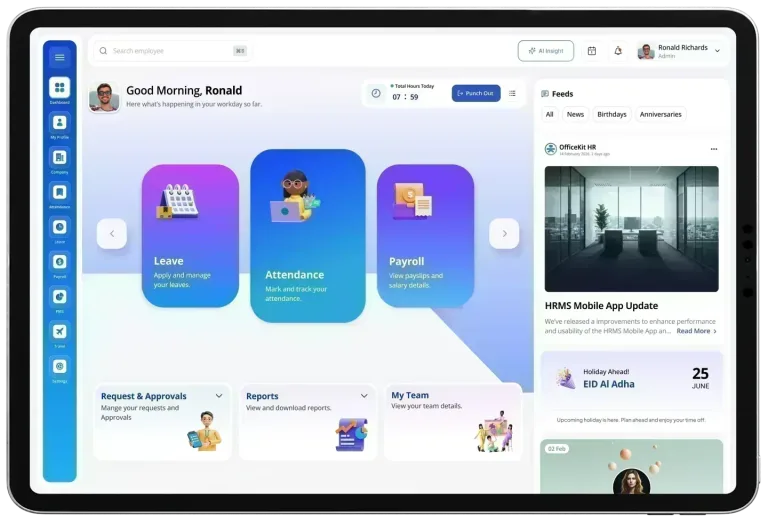
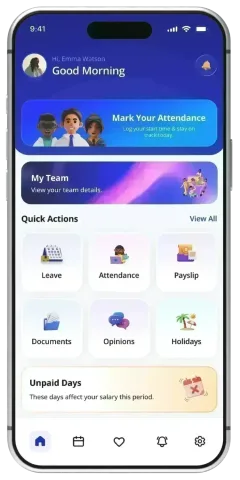
OfficeKit HR is built for companies that operate across the GCC and India. It runs payroll for all six GCC countries, including WPS salary files and social-insurance calculations, and Indian statutory payroll (PF, ESI, Professional Tax and TDS) in the same system. It also includes attendance with face recognition (Face-Kit), AI Pilot workflow automation, bilingual employee self-service and modular per-user pricing. It suits groups that would otherwise run separate HR systems for their Gulf and Indian entities.
Bayzat
Bayzat is a Dubai-based platform founded in 2013. It describes itself as an all-in-one HR, payroll, finance, insurance and benefits platform, and lists all six GCC countries. Its payroll is described as WPS and GOSI compliant, and in the UAE Bayzat is a licensed insurance broker for employee health cover. Bayzat Finance adds corporate cards, expenses and payments. It suits UAE-centred companies that want HR, payroll, health insurance and spend in one place.
ZenHR
ZenHR is an HR and payroll platform for the Middle East and North Africa. It lists localised payroll for Saudi Arabia, the UAE, Kuwait, Jordan, Egypt and Iraq, with native Saudi integrations for GOSI, WPS, Mudad and Muqeem. It has a bilingual Arabic–English interface and reports SOC 2 Type II compliance. Its modules include payroll, attendance, self-service, performance, an applicant tracking system and earned wage access. It suits Saudi-heavy employers and companies with staff across the wider MENA region.
GulfHR
GulfHR is a Dubai-based HR and payroll provider that says it has operated since 2003 and describes itself as the first Arabic-enabled HRMS. It lists Bahrain, Saudi Arabia, Kuwait, Qatar, the UAE, Oman, Jordan and Egypt. Its cloud platform covers payroll with WPS file generation, Saudi GOSI compliance, biometric and GPS attendance, mobile self-service, recruitment and performance. It suits GCC companies that want a long-established regional vendor.
If you also employ staff in India
Many Gulf companies run back-office or technology teams in India. Indian payroll has its own statutory rules for PF, ESI, Professional Tax by state and TDS, and since 21 November 2025 the new labour codes' wage definition as well. If you employ in both regions, ask each vendor whether Indian statutory payroll runs natively in the same system or through a partner. OfficeKit HR runs GCC and Indian payroll on one platform, with one employee record and one set of reports. Bayzat, ZenHR and GulfHR list GCC and wider-MENA countries; none lists India among its payroll countries on its own site or listing (checked October 2026).
How to run a fair evaluation
Shortlist two or three vendors and give each the same test: one month of real payroll for one entity, including a new joiner, a leaver with final settlement, an overtime run and the WPS salary file. Compare the results line by line, check how long corrections take, and ask for references from companies of your size in your countries. Pricing models differ (per user, per module, or bundled with insurance), so compare the full annual cost for your headcount.